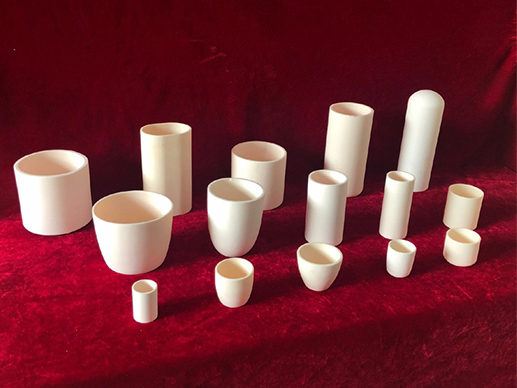
In the world of metallurgy and materials science, alumina ceramic crucibles are gaining widespread recognition for their superior performance in the melting of precious metals. These crucibles, crafted from high-purity alumina, have become indispensable tools for industries requiring high-temperature applications and exceptional material properties. Their usage spans a broad spectrum of sectors, including jewelry making, electronics, aerospace, and scientific research.
Unmatched Material Properties
Alumina, or aluminum oxide (Al2O3), is renowned for its excellent thermal stability, mechanical strength, and resistance to chemical attack. These attributes make alumina ceramic crucibles particularly suited for high-temperature environments, where other materials might fail. With a melting point exceeding 1700°C, alumina crucibles can withstand the intense heat required to melt precious metals like gold, silver, platinum, and palladium. Their high thermal conductivity ensures even heat distribution, preventing hot spots and ensuring uniform melting.
Advantages Over Traditional Materials
The advantages of alumina ceramic crucibles over traditional materials like graphite and quartz are numerous. Unlike graphite, alumina does not react with the metals being melted, which prevents contamination and ensures the purity of the molten metal. This non-reactivity is critical in industries like jewelry and electronics, where the quality of the end product depends heavily on the purity of the raw materials.
Moreover, alumina crucibles exhibit excellent wear resistance and durability. They do not degrade or deform under extreme temperatures, making them a cost-effective solution in the long run. Quartz crucibles, while also non-reactive, cannot match alumina's thermal shock resistance and mechanical strength, which are vital in high-temperature processes.
Applications in Various Industries
The application of alumina ceramic crucibles extends beyond metal melting. In the jewelry industry, these crucibles are essential for casting and refining precious metals, ensuring high-quality and defect-free products. In the electronics sector, they are used in the production of components that require precise and contamination-free melting processes, such as semiconductor wafers and integrated circuits.
Aerospace engineers rely on alumina crucibles for producing high-performance alloys and superalloys used in jet engines and other critical components. The ability to withstand extreme temperatures and corrosive environments makes alumina indispensable in this field. Additionally, scientific research laboratories utilize alumina crucibles for experiments involving high-temperature reactions and material synthesis, where the integrity of the experimental setup is paramount.
Technological Advancements
Recent advancements in manufacturing techniques have further enhanced the performance of alumina ceramic cruciblesL’amélioration des procédés de frittage et la mise au point de poudres d’alumine ultra-pures ont permis de fabriquer des creusets présentant une stabilité thermique et une résistance mécanique encore plus élevées. Les innovations dans la conception des creusets, telles que l’optimisation de leurs formes et dimensions, ont également contribué à une meilleure efficacité et un rendement accru dans divers procédés de fusion.
Considérations environnementales et économiques
D'un point de vue environnemental,creusets en céramique d'alumineElles offrent des avantages considérables. Leur durabilité et leur résistance à l'usure permettent de réduire la fréquence de remplacement, limitant ainsi les déchets et l'impact environnemental liés à leur fabrication et à leur élimination. De plus, l'utilisation de l'alumine, matériau abondant et non toxique, répond à la demande croissante de pratiques industrielles durables.
Sur le plan économique, l'investissement initial dans des matériaux de haute qualitécreusets en alumineLeur longévité et leur fiabilité compensent largement leur coût. Les industries bénéficient d'une réduction des temps d'arrêt et des coûts de maintenance, ce qui se traduit par une productivité et une rentabilité accrues. La pureté et la constance des produits obtenus grâce aux creusets en alumine renforcent également la valeur et la compétitivité globales des produits finis.